Monday, March 27, 2023

Write a Java program for the following: i) Create a doubly linked list of elements. ii) Display the contents of the list after deletion.

 import java.lang.*;


public class DoublyLinkedList

 {  

        class Node

        {  

        int data;  

        Node previous;  

        Node next;  

          public Node(int data) 

        {  

                this.data = data;  

        }  

    }  

     Node head, tail = null;  

      public void addNode(int data) 

   {  

        Node newNode = new Node(data);  

          if(head == null) 

            {  

                 head = tail = newNode;  

                   head.previous = null;  

                tail.next = null;  

        }  

        else

        {  

              tail.next = newNode;  

              newNode.previous = tail;  

              tail = newNode;  

              tail.next = null;  

        }  

    }  


    public void display() 

    {  

        Node current = head;  

        if(head == null) 

        {  

            System.out.println("List is empty");  

            return;  

        }  

        System.out.println("Nodes of doubly linked list: ");  

        while(current != null) 

        {  

             System.out.print(current.data + " ");  

            current = current.next;  

        }  

    }  


    public static void main(String[] args) 

    {  


        DoublyLinkedList dList = new DoublyLinkedList();  

        dList.addNode(1);  

        dList.addNode(2);  

        dList.addNode(3);  

        dList.addNode(4);  

        dList.addNode(5);  


        dList.display();  

    }  

}  


Output:

Nodes of doubly linked list: 

1 2 3 4 5 


Saturday, December 17, 2022

Data Mining R18

R18 Data Mining Lecture Notes for University Examinations for quick reference.

Unit-1 : Notes Click Here

Unit-1 : Data Preprocessing Click Here

Data Mining Unit-1 Important Question and AnswerClick Here

Introduction to Data Mining ppt Click Here

Data Discretization and Concept Hierarchy Click Here

Unit-2: Notes Click Here

Association Rule Mining ppt Click Here

Apriory Algorithm Click Here

Unit-3 : Notes Click Here

Lazy Learner and Rule Based Learning Click Here

Unit-4 : Notes Click Here

Hierarchal Clustering ppt Click Here

Partitioning Clustering ppt Click Here

Grid Based Clustering ppt Click Here

Density Based Clustering ppt Click Here

Unit-5

ppt on Data Streaming, Mining Time Series Data, Mining Sequential Click Here

ppt on Text Mining Click Here

ppt on Mining Spatial Data, Multimedia Data Click Here


Wednesday, June 1, 2022

VR23 Object Oriented Programming Though Java Notes

Object Oriented Programming Though Java Syllabus(VR23): Click Here

Unit-1 : 1st Part Notes Click Here

Unit-1 : 2nd Part Notes Click Here

Unit- 2 : Packages & Interfaces Notes Available

Unit-2 : Java.io Package  See Here

Unit-3 Hand written Notes   Click Here

Unit-4 Collection Framework PPT Download 

         Java.io PPT Download

       JDBC Connectivity PPT Downlaod 


Monday, May 23, 2022

Write a Java program to create an abstract class named Shape that contains two integers and an  empty method named print Area (). Provide three classes named Rectangle, Triangle, and Circle  such that each one of the classes extends the class Shape. Each one of the classes contains only  the method print Area () that prints the area of the given shape.

import java.util.*;

abstract class Shape {
	int length, breadth, radius;

	Scanner input = new Scanner(System.in);

	abstract void printArea();

}

class Rectangle extends Shape {
	void printArea() 
{
		
System.out.println("*** Finding the Area of Rectangle ***");
System.out.print("Enter length and breadth: ");
length = input.nextInt();
breadth = input.nextInt();
System.out.println("The area of Rectangle is: " + length * breadth);
	}
}

class Triangle extends Shape 
{
	void printArea()
 {
       System.out.println("\n*** Finding the Area of Triangle ***");
    System.out.print("Enter Base And Height: ");
    length = input.nextInt();
    breadth = input.nextInt();
 
System.out.println("The area of Rectangle is: " + (length * breadth) / 2);
  }
}

class Cricle extends Shape
 {
    void printArea() 
    {
	System.out.println("\n*** Finding the Area of Cricle ***");
	System.out.print("Enter Radius: ");
	radius = input.nextInt();

System.out.println("The area of Rectangle is: " + 3.14f * radius * radius);
    }
}

public class AbstractClassExample
 {
public static void main(String[] args)
 {
   Rectangle rec = new Rectangle();
   rec.printArea();

   Triangle tri = new Triangle();
   tri.printArea();
 		
   Cricle cri = new Cricle();
    cri.printArea();
}
}

Thursday, April 21, 2022

Java Programming

 Students blog for Happy Learning

Java Programming Syllabus(R18-CSE-JNTUH): Click Here

Object Oriented Programming Through Java Syllabus(R18-EIE-JNTUH): Click Here

Unit-1 : 1st Part Notes Click Here

Unit-1 : 2nd Part Notes Click Here

Unit Wise Important Questions: Download

Objective Questions :Download 

Tuesday, February 8, 2022

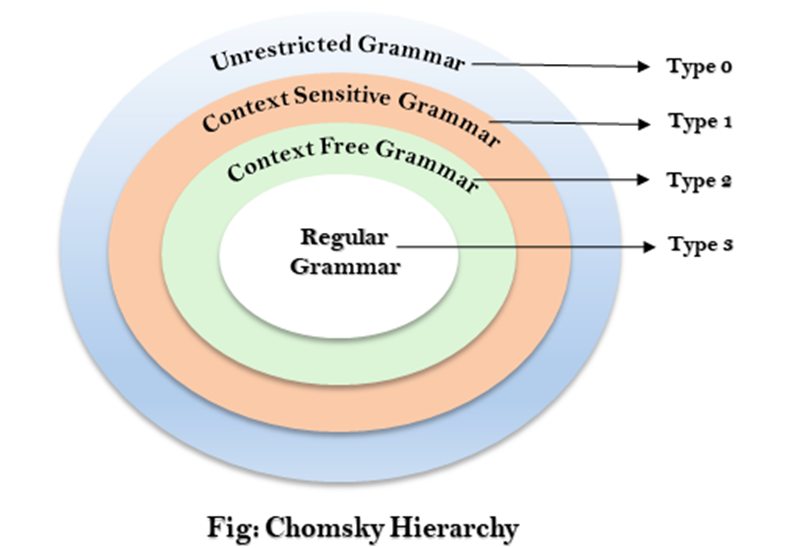
Chomsky Hierarchy

Chomsky Hierarchy

Chomsky Hierarchy represents the class of languages that are accepted by the different machine. The category of language in Chomsky's Hierarchy is as given below:

  1. Type 0 known as Unrestricted Grammar.
  2. Type 1 known as Context Sensitive Grammar.
  3. Type 2 known as Context Free Grammar.
  4. Type 3 Regular Grammar.


This is a hierarchy. Therefore every language of type 3 is also of type 2, 1 and 0. Similarly, every language of type 2 is also of type 1 and type 0, etc.

Type 0 Grammar:

Type 0 grammar is known as Unrestricted grammar. There is no restriction on the grammar rules of these types of languages. These languages can be efficiently modeled by Turing machines.

For example:

1.     bAa → aa  

2.     S → s  

Type 1 Grammar:

Type 1 grammar is known as Context Sensitive Grammar. The context sensitive grammar is used to represent context sensitive language. The context sensitive grammar follows the following rules:

  • The context sensitive grammar may have more than one symbol on the left hand side of their production rules.
  • The number of symbols on the left-hand side must not exceed the number of symbols on the right-hand side.
  • The rule of the form A → ε is not allowed unless A is a start symbol. It does not occur on the right-hand side of any rule.
  • The Type 1 grammar should be Type 0. In type 1, Production is in the form of V → T

Where the count of symbol in V is less than or equal to T.

For example:

1.     S → AT  

2.     T → xy  

3.     A → a  

Type 2 Grammar:

Type 2 Grammar is known as Context Free Grammar. Context free languages are the languages which can be represented by the context free grammar (CFG). Type 2 should be type 1. The production rule is of the form

1.     A → α  

Where A is any single non-terminal and is any combination of terminals and non-terminals.

For example:

1.     A → aBb  

2.     A → b  

3.     B → a  

Type 3 Grammar:

Type 3 Grammar is known as Regular Grammar. Regular languages are those languages which can be described using regular expressions. These languages can be modeled by NFA or DFA.

Type 3 is most restricted form of grammar. The Type 3 grammar should be Type 2 and Type 1. Type 3 should be in the form of

1.     V → T*V / T*  

For example:

1.     A → xy  


Pumping Lemma for L = {a | k is a prime number}

  L = {a | k is a prime number}

Let us assume L is regular.  

-> Clearly L is infinite (there are infinitely many prime numbers). From the pumping lemma, there exists a number n such that any string w of length greater than n has a “repeatable” substring generating more strings in the language L.

Let us consider the first prime number p >= n.

For example, 

if n was 50 we could use p = 53. 

From the pumping lemma the string of length p has a “repeatable” substring. We will assume that this substring is of length k >= 1.

Hence:

It should be relatively clear that p + k, p + 2k, etc., cannot all be prime but let us add k p times, then we must have:

so this would imply that (k + 1)p is prime, which it is not since it is divisible by both p and k + 1. Hence L is not regular. 


Pumping Lemma for Regular Languges


Pumping lemma used to show that language is not regular. 

What is pumping?

for regular expression

r = (a u b) (abb)* (bba u bbb), the string w= babbbbb pumps because we may decompose w into three sub strings.

w= b.  abb.  bbb

such that  b(abb)i bbb is represented by r, for every i>= 0.

in this DFA.,


the string aaabab= aa. aba.b pumps because of the cycle that the aba follows.


Suppose L is a regular Language., the there exists an integer k such that for all strings z belongs to L. , satisfying |z|>=k., we can write z= uvw where

|v| >= 1

|uv| <=k

u vw  belongs to L, for all i>=0.


Tuesday, January 18, 2022

FLAT(Formal Languages and Automata Theory) -VR23

FLAT Syllabus( VR23-CSE- Vignan Institute of Technology and Science- An Autonomous Institution ): Click Here

Unit-1 : Hand Written Notes Click Here


Unit-2 : Hand Written Notes Click Here


Unit-3 : Hand Written Notes Click Here


Unit-4 : Hand Written Notes Click Here

New notes on Push Down Automata and Turing Machine   Click Here


Unit-5 : Notes Click Here

Unit Wise Important Questions (Question Bank): Download

JNTUH FLAT Previous Questions: Download


Monday, January 17, 2022

Web Technologies

 Students blog for Happy Learning

Web Technologies Syllabus(R18-CSE-JNTUH): Click Here

Unit-1 : Notes Click Here

Unit-2 : Notes Click Here

Unit-3: Notes Click Here

Unit-4 : Notes Click Here

Unit-5 : Notes Click Here

Unit Wise Important Questions: Download

JNTUH Unit Wise Previous Questions: Download


ppts on Unit-5(Java Script)

Presentations on Java Script

Introduction to Java Script, First Java Script Program & Variables in Java Script ppt

Functions & Event Handlers, Form Validation in Java Script ppt

A simple Java program to find the inverse of a given matrix

  import java.util.Scanner; public class MatrixInverse { public static void main (String[] args) { Scanner scanner =...